
Media Release - Opening of the Legal Year 2026
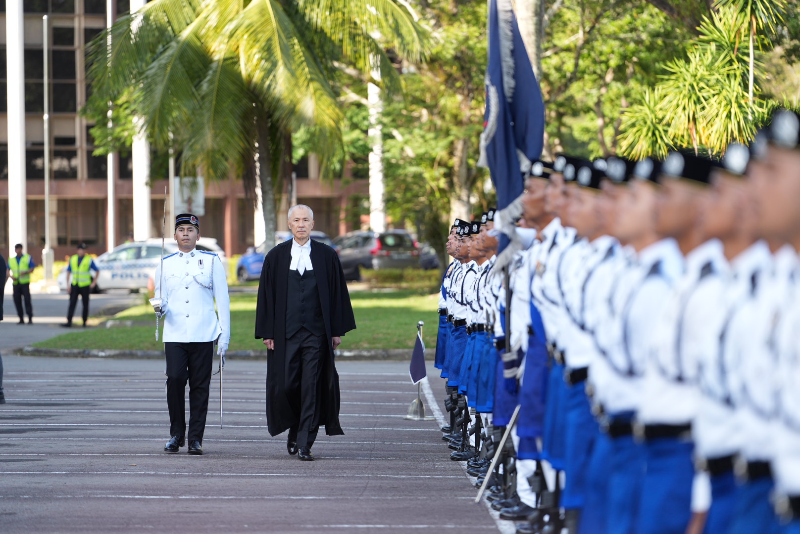
The Supreme Court of Brunei Darussalam hosted the Opening of the Legal Year 2026 on Thursday 22 January 2026 corresponding to 4 Syaaban 1447. The annual event gathered members of the Judiciary and the legal fraternity to mark the start of the court’s legal year.
The ceremony began with the traditional Guard of Honour parade by the Royal Brunei Police Force which was inspected by The Honourable Chief Justice of the Supreme Court, Dato Seri Paduka Steven Chong. This was followed by the Chief Justice’s address in which he reported on the Judiciary’s work and reforms in the past year and outlined strategic priorities for the year ahead.
In his address, the Chief Justice underscored the Judiciary’s contribution to Brunei Darussalam’s Vision 2035 in supporting economic diversification and attracting foreign investment. The Chief Justice noted that “an efficient, effective and competent Judiciary that resolves commercial disputes promptly fosters confidence among investors and businesses,” adding that judicial integrity and predictability “reduce commercial risks, encourage entrepreneurship, and signal to the global business community that the country is a trustworthy and attractive destination for investment.”
The Chief Justice referred to data from the World Bank in which Brunei Darussalam’s rule of law percentile rank is 79% as of 2023. He went on to explain that “Brunei Darussalam scores higher than approximately 79% of all other countries worldwide in terms of perceived rule of law in the quality of contract enforcement, property rights, the police and the courts”. This reflects the country’s strong rule of law environment and places it favourably among regional counterparts such as Singapore (98%), Japan (92%), Hong Kong SAR (88%) and South Korea (86%).
Turning to caseload data for 2025, the High Court recorded an increase in civil filings alongside a broadly stable criminal caseload. The Intermediate Court continued to manage a significant volume of work, particularly in commercial cases, with a slight increase in criminal matters. The Magistrate’s Court continued to carry the largest share of the Judiciary’s caseload, with notable increases in criminal filings across all districts, with the exception of road traffic cases which declined overall. In terms of bankruptcy and insolvency matters, a high number of receiving orders, adjudication orders and company winding-up orders were granted. The Civil Marriage Registry saw a marked increase in marriage registrations and a corresponding decline in divorce petitions. The Chief Justice observed that these figures “illustrate the breadth of the Judiciary’s work and the sustained demand placed on court services and resources.”
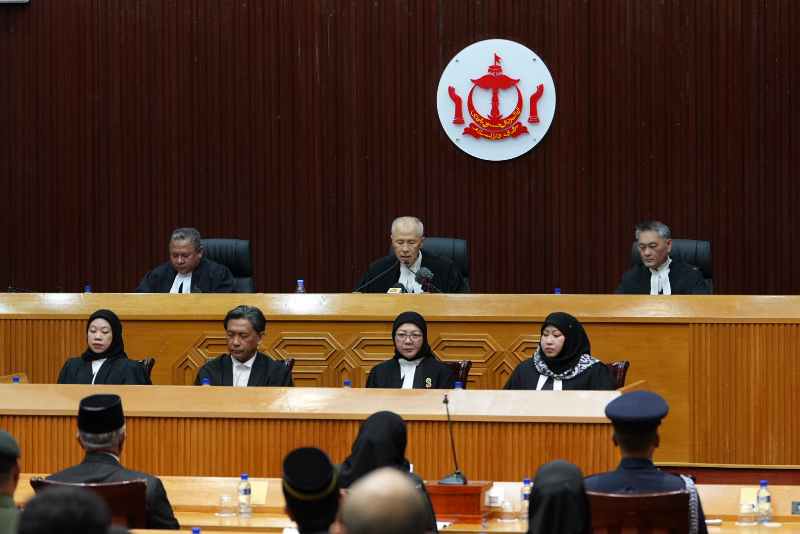
International and regional judicial cooperation featured prominently in 2025. A key ilestone which the Chief Justice highlighted was the renewed Memorandum of 2 Understanding (MOU) on judicial cooperation signed between the Supreme Court of Brunei Darussalam and the Supreme People’s Court of the People’s Republic of China. The Judiciary also participated in significant international forums, including the Pacific Judicial Conference, the Joint Judicial Conference between Brunei Darussalam, Malaysia and Singapore and multilateral engagements through the Council of ASEAN Chief Justices (CACJ) and ASEAN Law Association (ALA). Bilateral cooperation with key partners Australia, Malaysia, Singapore and the United Kingdom continued to deepen through professional exchanges and visits.
The Chief Justice updated on the work carried out by the Joint Legal Affairs Committee (JLAC) which continued the collaborative work by the Judiciary, the Attorney General’s Chambers and the Law Society in strengthening the legal profession. Key achievements include the completion of the second edition of the Personal Injury Award Guidelines, progress on the amendments to the Legal Profession Act and Rules and the endorsement of a pilot Court Friends Scheme aimed at improving access to justice for litigants in person.
Key initiatives for 2026 were announced by the Chief Justice, which include enhanced student engagement through a proposed ‘Open Day in Court’ programme and a pilot Judicial Internship Programme aimed at nurturing future legal talent and improving public understanding of the justice system. Reform of juvenile justice was listed as another priority, with an emphasis on rehabilitation, restorative practices and early intervention. The Judiciary will also develop guidelines on the responsible use of artificial intelligence by court users, and guidance relating to admission to the Bar will be reviewed in collaboration with the Law Society.
In concluding his remarks, the Chief Justice reiterated that “the effective administration of justice is a collective undertaking across our community.” He expressed appreciation to judges, judicial officers, court staff, the legal profession and law enforcement agencies for their continued dedication, noting that the reforms and initiatives outlined for 2026 reflect the collective commitment to justice and upholding the rule of law in Brunei Darussalam.
Speeches were then delivered by the Attorney General, Yang Berhormat Datin Seri Paduka Dayang Hajah Nor Hashimah binti Haji Mohammed Taib followed by the Vice President of the Law Society, Mr. On Hung Zheng, in representing advocates and solicitors in Brunei Darussalam.
The Opening of the Legal Year ceremony was attended by Yang Berhormat Pehin Datu Lailaraja Major General (Retired) Dato Paduka Seri Haji Awang Halbi bin Haji Mohd. Yussof, inister at the Prime Minister’s Office and Minister of Defence II, Yang Amat Arif/Yang Berhormat Pehin Orang Kaya Paduka Seri Utama Dato Paduka Seri Setia Ustaz Awang Haji Salim bin Haji Besar, Chief Syarie Judge and Yang Mulia Dato Seri Paduka Haji Sufian bin Haji Sabtu, Deputy Minister at the Prime Minister’s Office (Security and Law). The ceremony was also attended by Ambassadors, High Commissioners and members of the Diplomatic Corps, Senior Government Officials, members of the Judiciary from the Civil and Syariah Courts, Attorney General’s Chambers, Law Society, members of various government enforcement agencies and students from educational institutions.
SUPREME COURT OF BRUNEI DARUSSALAM / 22 JANUARY 2026